
Inventory management: from master data to excess and obsolete materials
Six steps that keep the warehouse from filling up again, and what we learned in practice

When Nicole DeHoratius and Ananth Raman examined nearly 370,000 inventory records in 37 stores of one retailer, 65% of the records were inaccurate: the quantity in the information system did not match the quantity on the shelf. The study was published in 2008 in Management Science and is still regarded as one of the foundational works on inventory accuracy.
A shop is not a factory, but the pattern is the same. The system proposes purchases, plans production and promises delivery dates on the basis of numbers that may be wrong. In manufacturing the problem is bigger still, because material changes along the way: it turns into semi-finished goods, scrap, rework and finished products.
In Less inventory, more cash, but not more profit we wrote about why reducing inventory releases cash but usually lowers EBITDA in the year of the reduction. Here we describe the second part: how to manage inventory so that a one-off project is not needed every few years.
Six steps, one system
The steps are not independent. The first four make sure the system knows the real stock and the real consumption. Only on this data can S&OP align purchasing and sales, and the sixth step cleans up what the others missed.
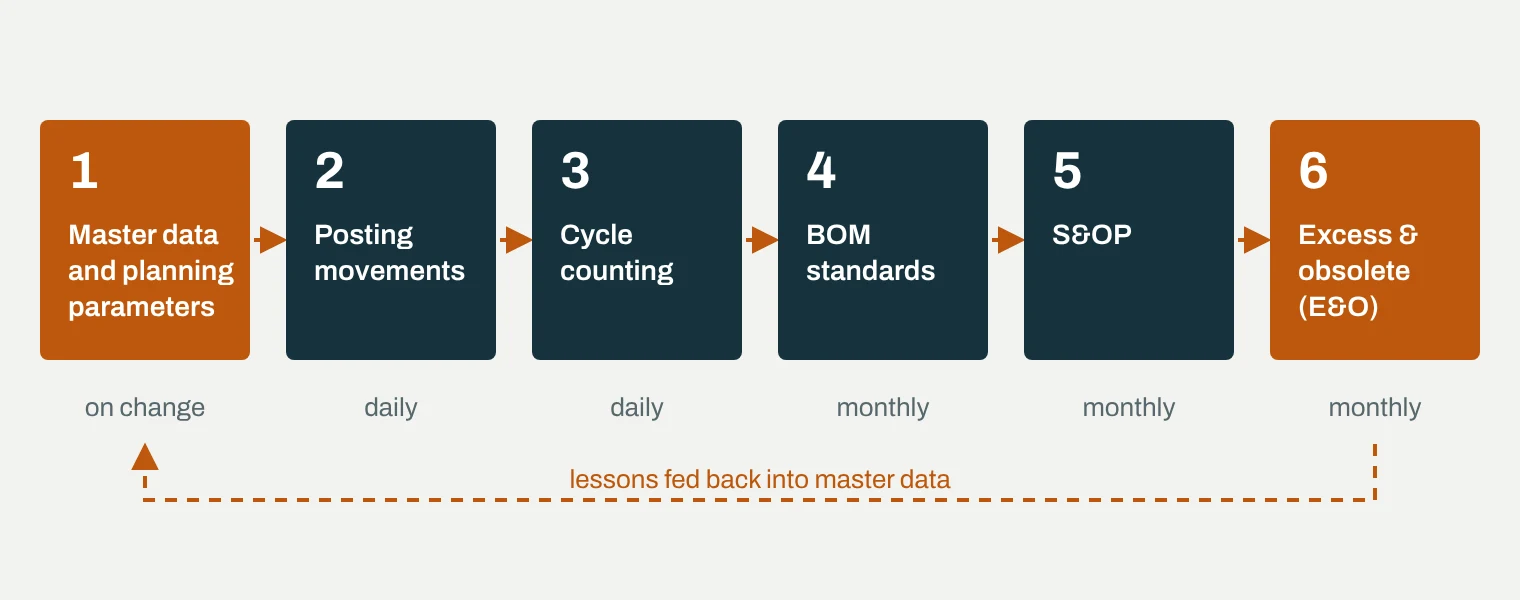
1. Master data and planning parameters
The ERP proposes purchases and production based on parameters someone once entered: safety stocks, minimum order quantities, lead times, reorder points, batch sizes. If they are outdated, the system correctly calculates the wrong purchase. Surplus is then not caused by a calculation error, but by data nobody checks any more.
From practice (CS02). At the electronic components manufacturer, sales orders in SAP were not correctly transferred into planned orders and purchasing. The system proposed purchases that did not need to be made. It was one of four causes behind a 76% rise in inventory over two years. Reconnecting sales orders, planned orders and purchasing was therefore one of the project's three actions.
A good rule: parameters for the most important materials have an owner, who checks them at least once a year and whenever a supplier, product or supply model changes.
2. Systematic posting of every movement
Inventory in the system is only as accurate as the postings. Consumption, scrap, rework, samples, returns and transfers between warehouses must be posted when they happen.
Postings are also the most reliable mirror of company culture. They involve a large part of the workforce: purchasing, logistics, quality, planners and production workers. Where people post consistently, they understand that the number in the system is worth something, and managers ask for it every day. Where people post "when there is time", it does not show up in one department but everywhere: in wrong inventory, unreliable costings and plans nobody believes any more. No new software fixes this. A manager does, by looking at open posting errors every day and asking why they are there.
From practice (CS01). In a metal-processing company with €5.4m revenue, the annual stock count revealed a €150,000 shortfall. The cause was not theft, but around 150 unconfirmed operations a month stuck in the ERP error queue. Material had been used but not posted to cost. EBITDA looked better than it was for a year, exactly when the owner was preparing the company for sale. At the sale multiple, the difference meant about €0.8m of purchase price. The errors were cleared and backflushing was introduced, so consumption is posted automatically.
3. Cycle counting
An annual stock count tells you how much is wrong, not why or when it happened. Cycle counting counts the warehouse continuously, in parts, and most often where value is highest.
From practice (CS01). We ranked materials by consumption value, then by size of count differences and frequency of postings. Key materials were counted eight times a year, others four or two times. The control system was running within four weeks, and inventory accuracy rose from 90.3% to 98.2% after the project.
An important rule: every cycle count difference has a cause that someone finds the same week. If you only correct the differences, you have replaced the annual count with a more expensive version of the same mistake.
4. Correct consumption standards in bills of materials
Steps 2 and 3 are the basis for this step. Once movements are posted and stock is verified, actual consumption by product can be compared with the standards, which can then be gradually corrected.
This matters most for expensive materials. With copper, stainless steel, electronic components or raw materials with volatile prices, a few percent difference per unit adds up over a year to a large amount that you see neither in the costing nor in the warehouse, only as a stock count difference at year end.
Wrong standards also spoil everything downstream: costings, MRP proposals and the purchasing plan. The system buys too much of what you use less of, and too little of what you use more of.
5. Aligned purchasing, production and sales plans: S&OP
Most surplus is not created in the warehouse but in meetings that never happen. Sales forecasts optimistically because it does not want to lose a customer. Purchasing buys "just in case" because it is punished for stock-outs, not for stock. Production runs large batches because changeovers are expensive. Each is right, and together they fill the warehouse.
Sales and operations planning (S&OP) is a monthly process in which sales, planning, purchasing, production and finance agree one demand number and derive one plan from it. In the end, management decides, not a single department. The next level is integrated business planning (IBP). It brings the financial plan, product development and strategy into the same monthly cycle: the volume plan is translated into euros, and management sees in one meeting what its decisions mean for revenue, margin and cash. In a mid-sized company, it makes sense to start with S&OP and extend it to IBP once the process is running.
Strategy&, PwC's strategy consulting arm, described companies that cut inventory by 20 to 30% after introducing the process. One of them raised its customer service level to above 98% at the same time. These are large companies, so do not transfer the percentages directly. In a mid-sized business, S&OP needs no special software: one spreadsheet, one hour a month and clear rules on who decides are enough.
6. Managing excess and obsolete stock
Excess and obsolete (E&O) stock will always arise: a customer cancels an order, a product is discontinued, a supplier changes its minimum order quantity. The difference is whether anyone decides about it.
A well-run process has three elements: a clear rule for when an item becomes E&O (for example no movement for six months, or stock covering more than twelve months of consumption), an owner for every item, and a monthly decision for each one: use, sell, return to the supplier or write off.
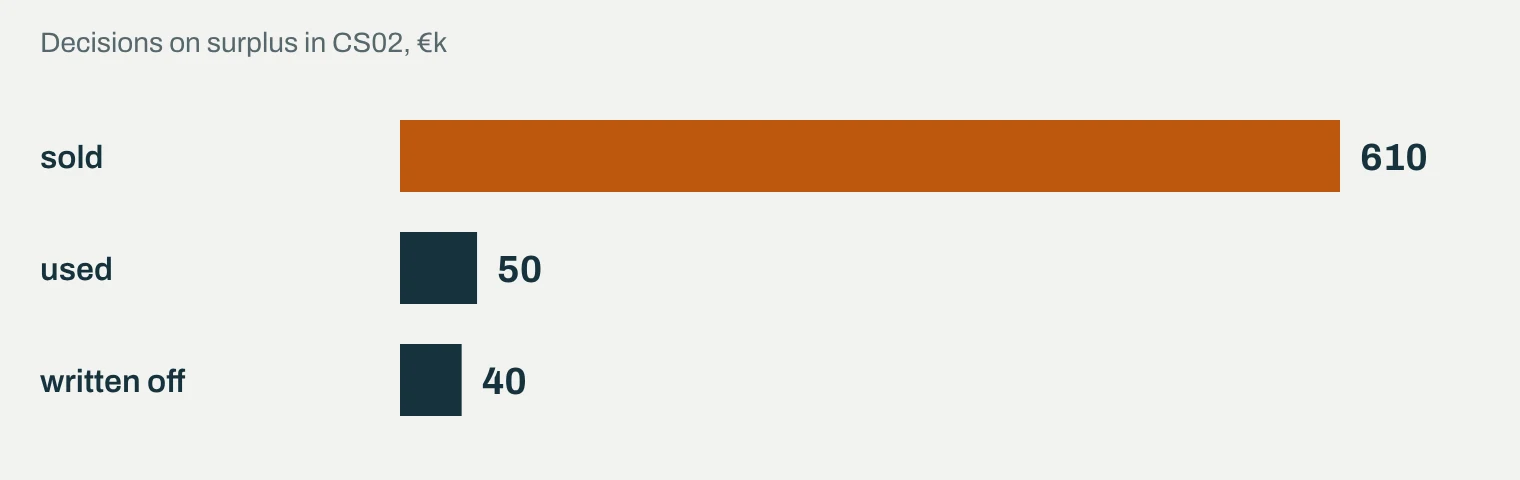
From practice (CS02). An electronic components manufacturer with €14m revenue decided on €700,000 of surplus item by item. €610,000 was sold, €50,000 used in production and only €40,000 written off. But what mattered most was what stayed: a policy on excess and obsolete stock, owned by the supply chain manager. The policy is still in force today.
What this means for your business
Small companies (up to €10m revenue). Start with steps 1, 2, 3 and 6. S&OP can be a half-hour monthly meeting of the managing director, sales and purchasing. Cycle counting can be done by a warehouse worker in one hour a day.
Mid-sized companies (€10–50m revenue). All six steps, with an owner for each. S&OP brings the most value only once the data beneath it is reliable, and without it the other steps fight the consequences of decisions made elsewhere.
Companies preparing for a sale. In due diligence, the buyer will check inventory accuracy and count differences first. Case CS01 shows why: every euro of overstated EBITDA counts several times over in a sale.
A simple framework: who, when, how we measure
| Step | Owner | Rhythm | KPI |
|---|---|---|---|
| Master data and parameters | planning manager | yearly and on change | share of parameters checked |
| Posting movements | production manager | daily | number of open posting errors |
| Cycle counting | warehouse manager | daily | inventory accuracy in % |
| Standards | process engineer | monthly | deviation of actual consumption from standard |
| S&OP | managing director or planning manager | monthly | forecast accuracy, inventory in days |
| E&O stock | supply chain manager | monthly | E&O value and share with a decision |
Five questions for your business
- Does your company have one demand number used by sales, purchasing and production, or does each have its own?
- How many posting errors are open in your ERP today, and who is responsible for them?
- When did you last check safety stocks, minimum order quantities and lead times in your ERP for your most important materials?
- When did you last compare actual consumption of your most expensive material with the standard in the bill of materials?
- How much of your stock has not moved for more than six months, and who last decided about it?
Where to start
Pick the ten materials with the highest consumption value. Count them every week for a month and find the cause of every difference. After a month, you will know which of the six steps is weakest in your business. In Value Mapping we do this in the first week, together with an estimate of how much cash is tied up in excess and obsolete stock.
Where AI helps across these six steps, and what must be in place first, we will describe in our next insight.
Sources: DeHoratius, N. and Raman, A. (2008), Inventory Record Inaccuracy: An Empirical Analysis, Management Science 54(4); Strategy& (PwC), A fresh look at sales and operations planning (2009); Armes, case studies CS01 and CS02.
Case study: Inventory control (PDF) ↗
Less inventory, more cash, but not more profit
Reducing inventory releases cash, but EBITDA usually falls in the year of the reduction. Three traps, a case from practice, a board table and six steps to keep the warehouse from filling up again.
AI: adopt fast, or first protect what sets you apart?
Alex Karp says model providers are "stealing the alpha" of businesses. What really happens to data, what it means for small, mid-sized and micro businesses, and five steps to adopt AI without losing know-how.